Spooky Spiders — More Than Meets the Eye
For most, spiders are the stuff of Halloween nightmares, but photographer and Entomology Collections volunteer Tasneem Ahsanullah captures the fascinating adaptations and diversity of these creepy-crawlies through her lens.
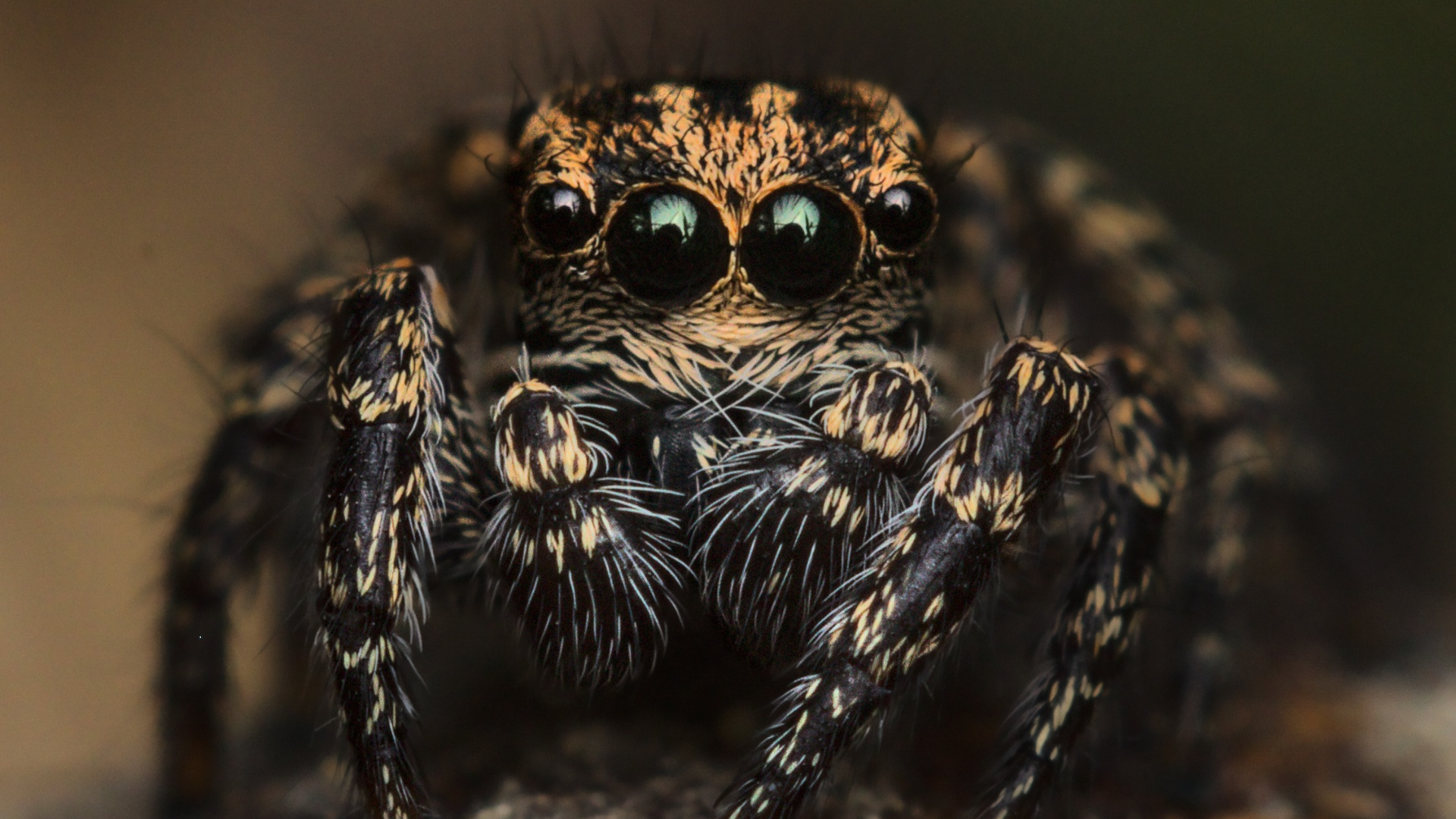
Photo by Tasneem Ahsanullah
Most people get creeped out when they think of spiders, but if you take a moment to look closer, I think you’d be surprised. Jumping spiders in particular are some of the most intelligent and interesting spiders I’ve photographed. Sometimes they’ll stare directly at my camera lens or some shyer ones will peek out from behind leaves. Through this article, I hope to show just how unique and diverse jumping spiders are.
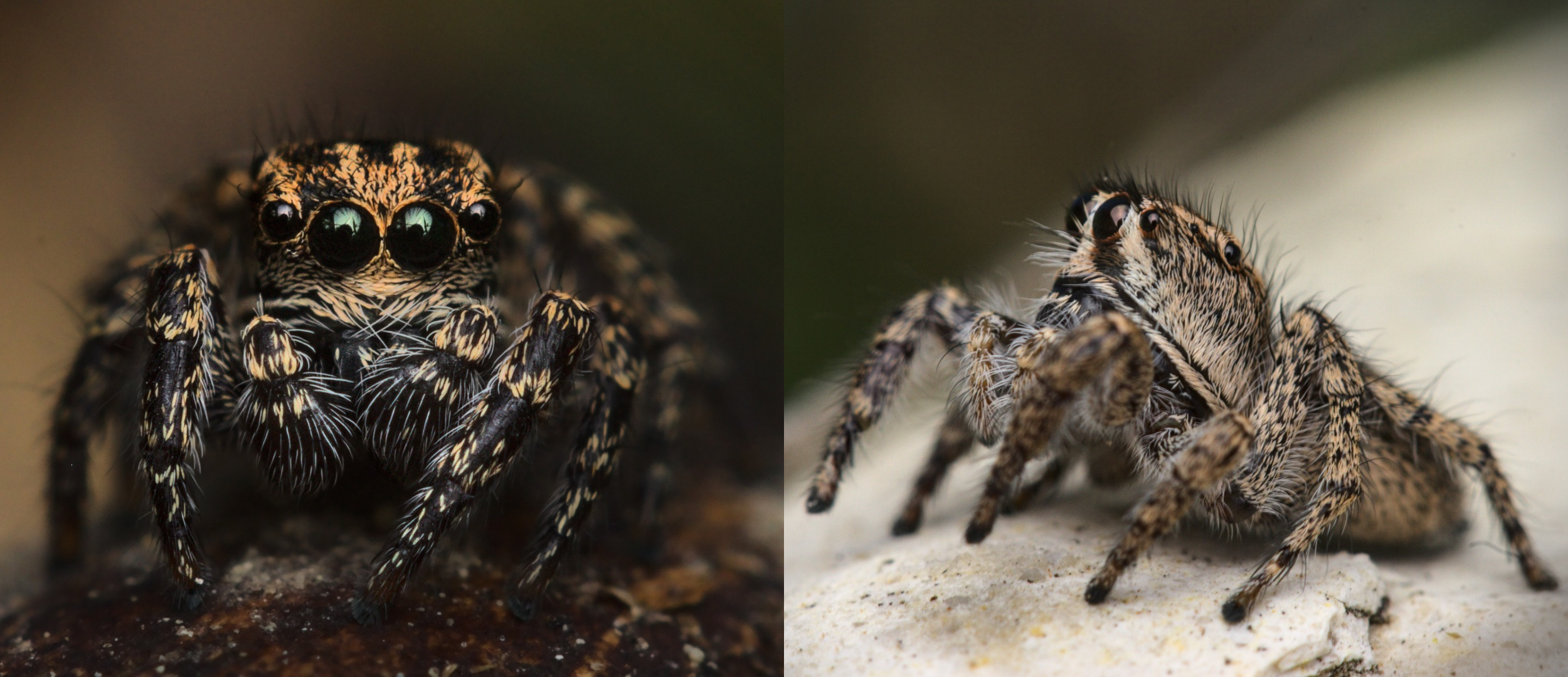
Paradise jumping spiders (Habronattus falax and Habronattus cognatus)
One of the jumping spider’s most prominent features is its eyes. Whenever I photograph them, I am always mesmerized by their wide reflective eyes staring back at me. Jumping spiders have eight eyes. The first four on the front of their face see in high resolution and can even see ultraviolet light. However, these eyes can only see with such sharp focus in a narrow X-shape. Their other four eyes are on the sides of their head. They are not as sharp is the front set but have a much wider view and can detect the slightest motion in their surrounding environment. Typically, the side set of eyes detect prey and the front set focuses on the prey. This is very different from how us humans use our eyes, but for the jumping spider, this set up is very efficient.
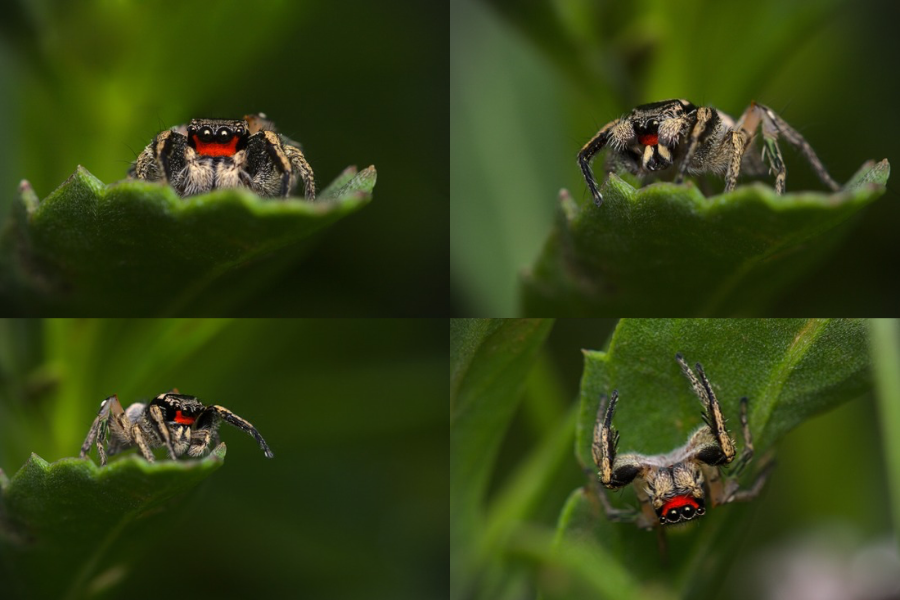
Paradise jumping spider (Habronattus coecatus)
One genus of jumping spiders called Paradise jumping spiders (Habronattus) have some of the most intricate mating rituals in the animal kingdom. Paradise jumping spiders get their name because of their elaborate courtship behaviors and colorful body parts similar to birds of paradise. During mating, the males communicate with the females through two modes: visually and vibrationally. They “dance” by swinging their legs and flashing their bright, colorful faces. In my opinion, the more interesting part of the courtship is the part we cannot perceive. The males contract different parts of their bodies in a rhythmic pattern which creates vibrations that travel through the surface they are standing on (leaves, bark). These vibrations are then received by the females through the hairs on their legs.
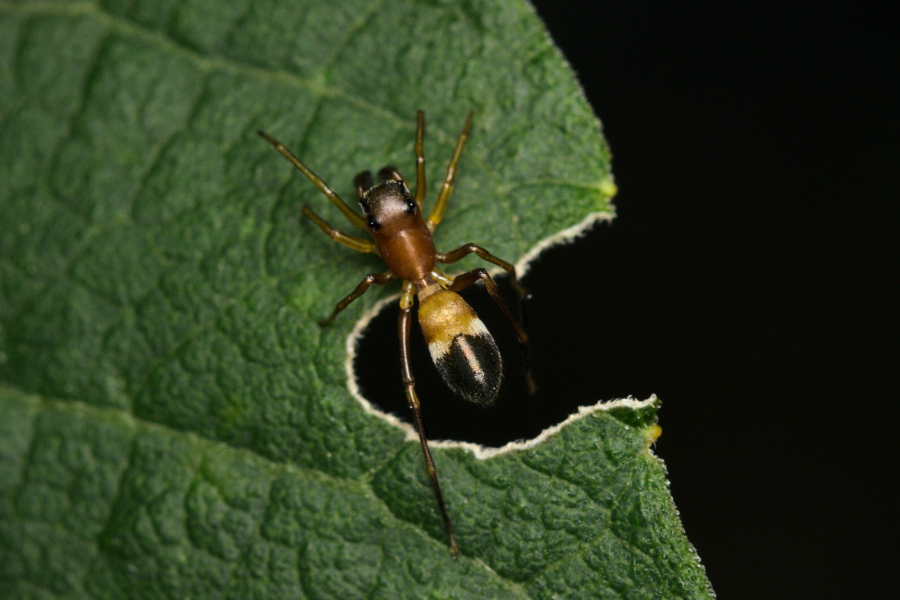
Ant-mimic jumping spider (Sarinda hentzi) at the Lady Bird Johnson Wildflower Center
Other species of jumping spiders are masters of mimicry. The spider pictured above is a jumping spider (Sarinda hentzi) mimicking an ant! When I first saw this spider, I thought I was photographing an ant, but when I saw it jump, I became suspicious. However, when I took a closer look at my photo and noticed it had 8 legs instead of 6, I realized I’d been fooled by a spider. Some spiders mimic ants because ants are aggressive and have dangerous stings/chemicals which are unappealing to predators, while other spiders mimic ants to gain access to ant colonies and feast on the ants. Spiders can mimic behavior, as well as appearance; the spider I photographed even waves its front legs to mimic an ant’s antennae. Nature is full of mimicry, and I’m always amazed by how well some animals mimic others.
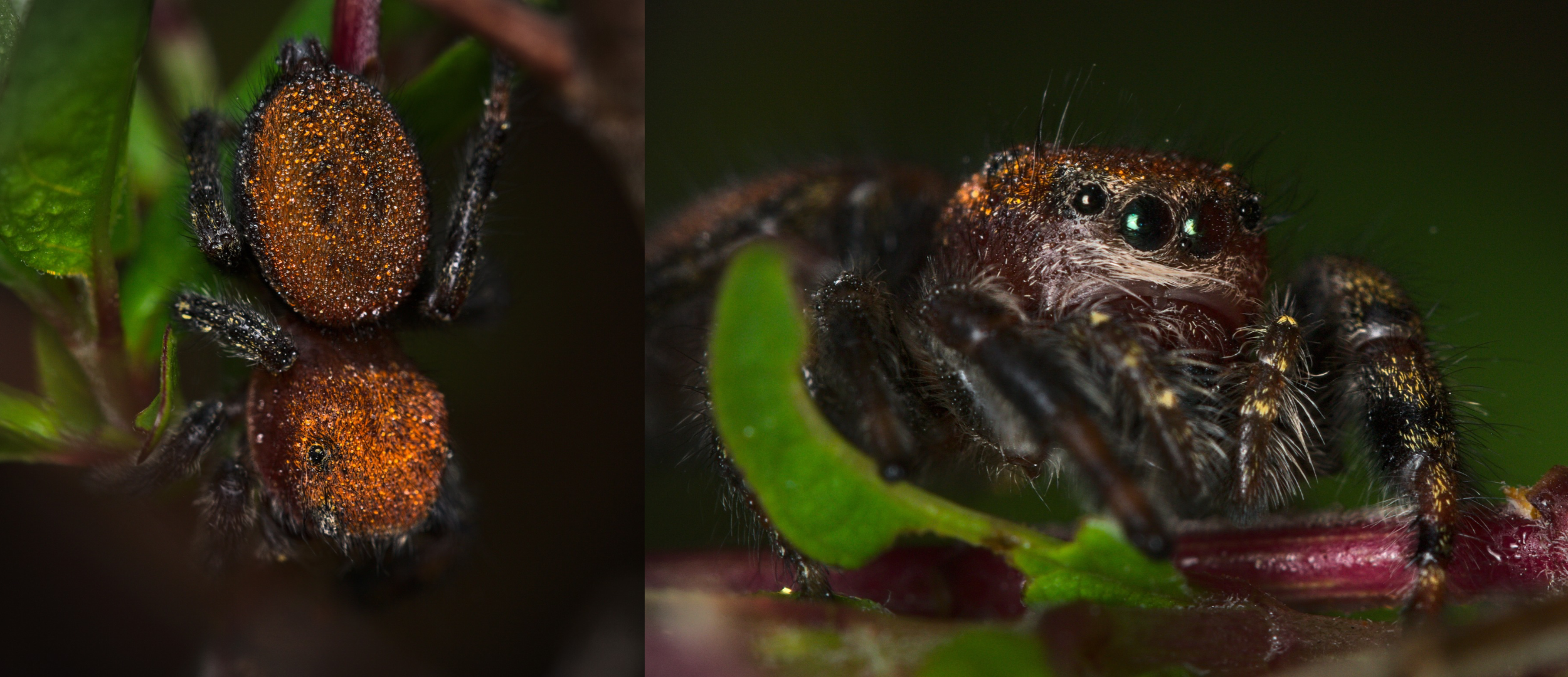
Cardinal jumping spider (Phidippus cardinalis) at the Lady Bird Johnson Wildflower Center
The Cardinal jumping spider (Phidippus cardinalis) is another ant-mimicking spider. The day I photographed this one, I was lucky because it was covered in beautiful droplets of morning dew. Cardinal jumping spiders have a very striking bright orange/red color to mimic velvet ants from the genus Dasymutilla. Velvet ants have a very painful sting so looking like oneis advantageous to cardinal jumping spiders because predators will avoid them.
Jumping spiders are incredible creatures that many of us overlook. From their incredible vision to their intricate courtship and mimicry, these spiders are marvels of evolution. Whenever I see jumping spiders now, I try to imagine what it would be like to perceive the world through their eyes.
Sources:
Ed Yong – An Immense World (Book)
https://edyong.me/an-immense-world
See the world through a jumping spider’s eyes — and other senses
https://www.snexplores.org/article/jumping-spider-vision-eyes-color-senses-hearing-mating-courtship
Jumping spider communication – how vibrations control their courtship
The Harvard Gazette – Making eight legs look like six